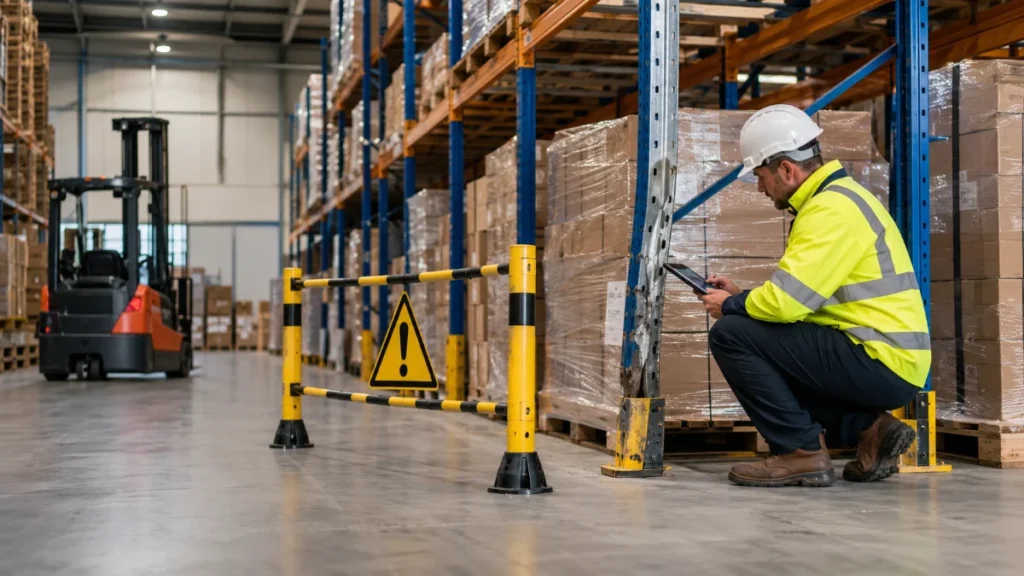
If you find defective racking, your first action should be simple: stop using the affected racking location and make the area safe. That means preventing further loading, restricting access where needed and making sure nobody treats the damage as “one to sort later”.
In a busy warehouse, damaged racking can be easy to underestimate. A bent upright, dislodged beam connector, missing locking pin or twisted brace might look minor from the aisle. Under load, during forklift movement or when a pallet is placed slightly off-centre, that same defect can become a much bigger problem.
This guide explains what Warehouse Managers and Operations Managers should do first, what should happen next and why trained staff make a huge difference to racking safety. It is also a useful companion to our racking inspection training, which helps your team identify, classify and record racking issues with confidence.
What Is the First Action When You Find Defective Racking?
The first action is to stop using the affected bay, location or run of racking until the risk has been assessed. Do not wait for the next planned inspection. Do not load more pallets into the damaged position. Do not assume it is safe because the rack is still standing.
In practical terms, the first few minutes should look like this:
- Keep people and MHE away from the affected area if there is any immediate concern.
- Prevent further loading into the damaged bay or adjacent positions if they may be affected.
- Report it to the Person Responsible for Racking Safety, warehouse supervisor or site safety lead.
- Record the exact location, racking reference and visible defect.
- Arrange a competent assessment before the racking is returned to use.
The key point is not to “inspect it properly later” while operations continue as normal. The first action is control. Assessment comes next.
Why Immediate Control Matters More Than Immediate Repair
A common mistake is thinking the first action should be to repair the defective racking straight away. That sounds sensible, but it skips an important step.
Before repair, someone competent must understand the nature of the defect. Is it a damaged upright? Has a beam been struck? Are the beam connectors still correctly engaged? Is the frame out of plumb? Has the floor fixing failed? Has the rack been overloaded or altered from its original design?
Different defects carry different levels of risk. A missing beam safety lock is not the same as a heavily deformed upright. A scrape on paintwork is not the same as a twisted frame brace. A rack that has been struck repeatedly in the same location may point to a traffic management issue, not just a maintenance issue.
This is where trained judgement matters. Your team needs to know when a location can be monitored, when it must be emptied as soon as practicable and when it should be offloaded immediately.
For official context, the Health and Safety Executive provides wider workplace safety guidance, while SEMA is the recognised UK authority for storage equipment safety guidance and racking inspection best practice.
Defective Racking and the Red, Amber, Green System
Racking defects are commonly classified using the Red, Amber and Green risk system. This helps warehouse teams prioritise action rather than treating every defect in the same way.
| Risk category | What it generally means | Typical first action | What happens next |
|---|---|---|---|
| Red risk | Serious damage or unsafe condition. | Offload immediately if safe to do so, isolate and take out of use. | Repair or replace before reuse. Do not reload until confirmed safe. |
| Amber risk | Damage requiring remedial action, but not necessarily immediate offloading. | Do not refill once emptied. Prevent further loading into the affected location. | Repair within the required timescale and monitor until completed. |
| Green risk | Damage within acceptable limits or requiring monitoring. | Record and monitor as part of routine inspections. | Review regularly to ensure it does not worsen. |
This traffic light approach is useful because it avoids two common problems. The first is overreacting to every minor issue, which can create unnecessary disruption. The second is underreacting to damage that could compromise the structure.
The difficulty is that the classification is only as good as the person making the judgement. A dented upright at low level in a high-traffic aisle may deserve more scrutiny than the same-looking mark in a low-risk area. Damage patterns, load levels, component type and rack configuration all matter.
That is why many warehouses benefit from having a trained PRRS or nominated competent person on site. Our racking inspection training is designed to give your internal team the confidence to identify defects, understand SEMA damage classifications and know when to escalate an issue.
Do Not Keep Using Defective Racking “Just Until the End of the Shift”
This is one of the most risky habits in warehouse operations.
Everyone understands the pressure. Goods need to move. Pick faces need replenishing. Despatch deadlines do not pause because someone has spotted a bent upright. But continuing to use defective racking can turn a manageable issue into an incident that affects people, stock, equipment and business continuity.
The safest approach is to separate the operational decision from the safety decision. Once a defect is identified, the question is not “Can we get away with using it for another few hours?” The question is “Has a competent person confirmed what level of risk this presents?”
Until that answer is clear, the affected location should not be treated as normal storage.
What Should You Record When Defective Racking Is Found?
Good records protect people and help managers make better decisions. They also show that the site has a structured process for identifying, reporting and acting on racking defects.
At minimum, your record should include:
- The exact location, including aisle, bay, beam level and pallet position.
- The date and time the defect was found.
- The person who reported it.
- Photographs from a safe position.
- The component affected, such as upright, beam, bracing, floor fixing, baseplate or locking pin.
- The immediate control measures taken.
- The risk classification, if assessed by a competent person.
- The repair, replacement or follow-up action required.
Photos are particularly useful, but they should not replace proper inspection notes. A close-up image of a dent may miss the wider issue, such as an out-of-plumb frame, repeated impact damage, missing protection or poor pallet placement.
For multi-site operations, consistent record keeping is even more important. If every depot describes and grades defects differently, it becomes difficult to compare risk, track recurring damage or budget for remedial work.
Who Should Assess Defective Racking?
Defective racking should be assessed by someone competent to understand racking damage, risk classification and appropriate action. In many warehouses, this will involve a trained Person Responsible for Racking Safety for routine checks, supported by periodic inspections from a SEMA Approved Racking Inspector.
There is a useful distinction here:
| Role | Best suited for | Limitations |
|---|---|---|
| Warehouse operative | Spotting and reporting visible damage during day-to-day work. | Should not be expected to classify structural risk unless properly trained. |
| Supervisor or Warehouse Manager | Taking immediate control, isolating areas and ensuring the reporting process is followed. | May need further training to classify damage accurately. |
| Trained PRRS or internal inspector | Routine internal inspections, initial classification and escalation decisions. | Should work within training limits and escalate uncertainty. |
| SEMA Approved Racking Inspector | Independent annual inspections, complex defects, high-risk issues and formal reporting. | Not a substitute for day-to-day internal checks between inspections. |
A strong racking safety system uses all of these roles properly. Operatives spot issues. Supervisors control the area. Trained staff assess and record. Independent inspectors provide expert oversight.
The Defects Competitors Often Explain Poorly
Many guides talk about “damaged racking” as if it is one simple category. In real warehouses, defects are more varied and more nuanced.
Beam damage is not just about visible bending. You also need to check whether beam connectors are seated correctly, whether safety locks are present and whether the beam shows signs of twisting or overloading.
Upright damage is not always obvious from the front. Low-level impact damage can affect the load path through the frame, especially in forklift traffic zones and end-of-aisle positions.
Bracing damage is often overlooked because it sits behind the front face of the rack. Damaged horizontal or diagonal bracing can affect frame stability, particularly where there has been side impact.
Missing or loose floor fixings can be a serious issue, especially where racks are subject to impact, uneven floors or changes in loading pattern.
Incorrect pallet placement can look like an operational problem rather than a racking defect, but poor positioning can overload beams, damage components and increase the chance of pallet instability.
Unauthorised repairs can create hidden risk. Welding, heating, drilling or modifying rack components without manufacturer approval can compromise the integrity of the system. Damaged components should be repaired or replaced using appropriate parts and competent methods.
For teams involved in remedial work, our racking maintenance training helps build a better understanding of safe maintenance practice, component function and the limits of what should be handled in-house.
What Not to Do When You Find Defective Racking
Knowing what not to do is just as important as knowing the correct first action.
Do not straighten damaged components with a hammer, forklift or improvised method. Do not weld a damaged upright unless the repair has been properly specified and approved. Do not remove damaged bracing and continue using the rack. Do not reload an amber or red location because space is tight. Do not assume that a rack is safe simply because it has carried the load before.
Also, do not rely on annual inspections alone. An annual inspection is important, but racking can be damaged five minutes after the inspector leaves site. Internal checks, staff awareness and clear reporting routes are what keep the system controlled between formal inspections.
How Training Changes the First Response
When staff are not trained, the first response to defective racking is often inconsistent. One supervisor may isolate the bay immediately. Another may leave it until maintenance is available. One shift may report every visible defect. Another may only report damage when pallets become difficult to store.
Training creates a shared standard. It helps your team understand:
- which rack components are structurally important;
- what common damage looks like;
- how Red, Amber and Green classifications work;
- when to isolate, monitor or escalate;
- how to record defects clearly;
- how forklift activity, pallet quality and layout affect racking damage.
For Warehouse Managers, this is not just a compliance exercise. It improves decision making on the floor. It also helps reduce repeat damage because teams become better at spotting the causes, not just the symptoms.
If your site has frequent rack strikes, repeated upright damage, missing locking pins or uncertainty around inspection records, it may be time to review whether your internal team has had enough practical training. Our on-site racking inspection training can be tailored around your actual racking layout, MHE activity and working environment.
When Should You Call a SEMA Approved Racking Inspector?
You should call a SEMA Approved Racking Inspector when the damage is serious, unclear, recurring, difficult to classify or outside the competence of your internal team.
It is also sensible to seek expert support when:
- racking has been struck by MHE;
- uprights, beams, bracing or floor fixings show visible deformation;
- loads have shifted or pallets appear unstable;
- racking has been altered, moved or reconfigured;
- load notices are missing, unclear or no longer match the configuration;
- there is disagreement internally about whether the rack is safe to use.
An independent inspection gives you more than a list of defects. A good report should identify the location, component, risk category and recommended action, with enough clarity for managers to prioritise remedial work.
UK Rack Inspection provides independent inspections and training across the UK. We do not use inspections as a way to push repair work, so our advice is focused on safety, compliance and practical risk control.
Get a Quote
With over 30 years of experience our fully SEMA approved inspectors offer nationwide racking inspection and training.
Common Misconceptions About Defective Racking
“It is only a small dent.”
Some small marks are low risk. Others are more significant because of where they are, what component they affect and how the rack is loaded. Location and context matter.
“The rack is still standing, so it must be safe.”
Racking does not need to collapse immediately to be unsafe. A damaged component can reduce the safety margin of the structure and increase the risk during future loading, unloading or impact.
“We will sort it during the annual inspection.”
Defects should be reported and controlled when they are found. Annual inspections are important, but they should sit alongside regular internal checks.
“Our maintenance team can repair anything.”
Maintenance teams are valuable, but racking repairs need the right components, the right method and an understanding of the original system. Improvised repairs can create liability and safety issues.
“Training is only needed for inspectors.”
Formal inspectors need specialist competence, but warehouse teams also need enough knowledge to spot defects, report them properly and take the right first action.
A Practical First-Action Procedure for Warehouse Managers
If your site does not already have a clear procedure, use the following as a starting point and adapt it to your racking system, layout and risk assessment.
| Step | Action | Purpose |
|---|---|---|
| 1 | Stop use of the affected location. | Prevents further loading or disturbance before assessment. |
| 2 | Make the area safe. | Reduces risk to pedestrians, MHE operators and nearby stock. |
| 3 | Report to the nominated responsible person. | Ensures the issue enters the formal safety process. |
| 4 | Record the location and defect. | Creates traceability and supports remedial planning. |
| 5 | Arrange competent assessment. | Confirms risk classification and next action. |
| 6 | Repair, replace, monitor or escalate. | Closes the loop and prevents unresolved defects being forgotten. |
The important part is consistency. A simple procedure followed every time is far more effective than a detailed policy that nobody uses on the warehouse floor.
How to Reduce Defective Racking in the First Place
The best racking safety systems do not just react to defects. They look for patterns.
If the same end frame is hit every month, the issue may be aisle width, turning space, driver behaviour, poor visibility or inadequate protection. If beams are repeatedly damaged, pallet handling, beam height or load type may need review. If locking pins regularly go missing, your inspection routine may need tightening.
Useful preventative measures include:
- regular internal rack checks by trained staff;
- clear rack location labelling;
- up-to-date load notices;
- good housekeeping around aisles and picking areas;
- reviewing forklift routes and turning points;
- using suitable rack protection where impact risk is high;
- recording repeat damage by location, not just by defect type.
This is where racking inspection becomes a management tool, not just a compliance task. Done properly, it helps you reduce downtime, control repair costs and create a safer working environment.
Conclusion: Stop, Make Safe, Report and Assess
When you find defective racking, your first action is not to ignore it, repair it casually or wait for the next inspection. Your first action is to stop using the affected location, make the area safe and ensure the defect is reported and assessed by someone competent.
For Warehouse Managers and Operations Managers, the real goal is consistency. Everyone on site should know what to do when damage is found, who to tell and when racking must be taken out of use. If that process currently depends on guesswork, our racking inspection training can help your team build the confidence and competence to respond properly.
Need help improving your internal racking inspection process? Speak to UK Rack Inspection about practical, on-site training tailored to your warehouse, your racking and your team.
Get a Quote
With over 30 years of experience our fully SEMA approved inspectors offer nationwide racking inspection and training.
FAQs About Defective Racking
What should be your first action when you find defective racking?
Your first action should be to stop using the affected racking location and make the area safe. Prevent further loading, report the defect and arrange for a competent person to assess the risk before the rack is used again.
Can defective racking still be used if the damage looks minor?
Only if it has been assessed and confirmed as safe to remain in use. Some visible damage may be low risk, but other defects can affect structural integrity even if they appear minor. When in doubt, stop use and escalate.
Who is responsible for reporting damaged warehouse racking?
Everyone who works around racking should report visible damage, but the site should have a nominated responsible person, often a PRRS, supervisor or Warehouse Manager, who ensures the issue is recorded, assessed and actioned.
Does damaged racking always need to be unloaded immediately?
Not always. Red risk damage normally requires immediate offloading if it is safe to do so. Amber risk damage may not require immediate offloading, but the location should not be refilled once emptied until repairs are completed. A competent assessment is essential.
What are the most common signs of defective racking?
Common signs include bent uprights, damaged beams, missing beam locking pins, twisted bracing, loose floor fixings, damaged baseplates, corrosion, over-deflection, missing load notices and pallets sitting incorrectly on beams.
Can our own maintenance team repair defective racking?
They may be able to carry out certain tasks if they are trained, competent and using correct components and approved methods. Structural racking repairs should never be improvised. If there is uncertainty, seek advice from a competent racking specialist.
How often should racking be inspected for defects?
Racking should be checked regularly by trained internal staff, with a formal expert inspection at suitable intervals. Many sites arrange an annual inspection, but the frequency of internal checks should reflect site activity, MHE use, damage history and risk level.
What training helps staff deal with defective racking?
Racking inspection training helps staff identify damage, understand racking components, use Red, Amber and Green classifications, record defects correctly and know when to escalate issues for expert inspection or repair.