
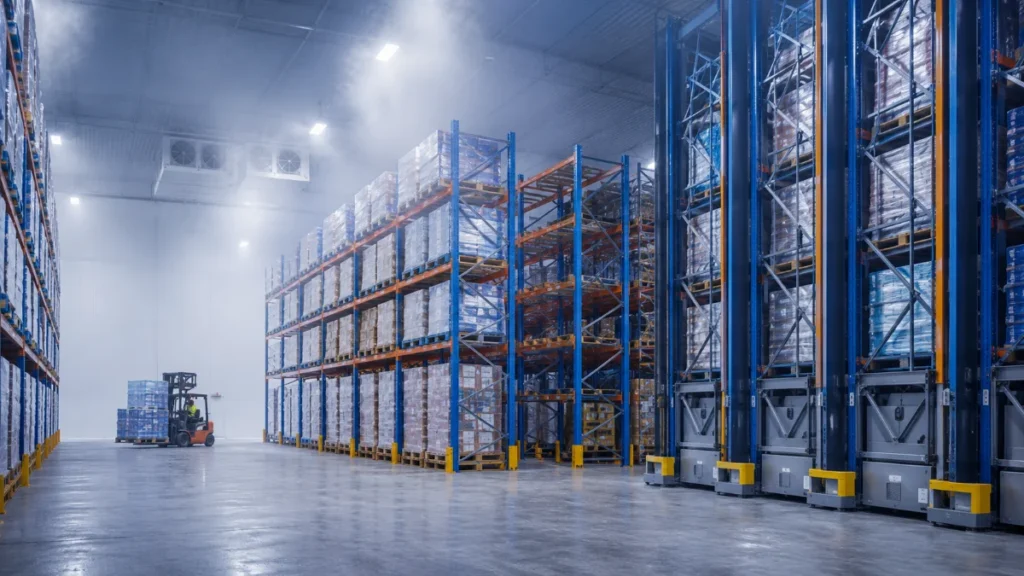
Cold Storage Racking Systems must balance several competing demands: storage density, stock access, pallet throughput, temperature control and safe forklift movement. The right system can make far better use of an expensive temperature-controlled footprint, but each layout also creates its own inspection challenges and damage risks.
Adjustable pallet racking, drive-in racking, mobile racking and block stacking can all work effectively in chilled or frozen warehouses. The best option depends on the products being stored, stock rotation requirements, pallet condition, vehicle movements and the level of access needed.
This guide explains how the main systems work, where they add value and what warehouse managers should consider when planning routine checks and professional Cold Storage Racking Inspections.
Why Racking Choice Matters in a Cold Storage Warehouse
Cold storage space is expensive to build, cool and operate, so it is understandable that businesses want to maximise every available cubic metre. Increasing storage density, however, can reduce aisle space, limit direct pallet access and make some parts of the racking harder to inspect.
The best layout is not simply the one that holds the most pallets. It must also support safe loading, suitable stock rotation and efficient day-to-day operation.
Key considerations include:
- the number of product lines and pallet types being stored
- whether stock requires FIFO, LIFO or date-controlled rotation
- the frequency of pallet movements
- forklift type, turning space and operating clearances
- the quality and consistency of incoming pallets
- inspection and maintenance access
- temperature, condensation and ice-related risks
- whether future layout changes are likely
It is also important to remember that a configuration that worked for the original operation may no longer be suitable after changes to stock, pallet weights, beam levels or handling equipment.
Common Types of Cold Storage Racking Systems
The most suitable solution will depend on how the warehouse operates. The following systems are commonly used in chilled, frozen and temperature-controlled storage facilities.
Adjustable Pallet Racking in Cold Storage
Adjustable pallet racking, often shortened to APR, is one of the most widely used storage systems. Each pallet position is normally accessible directly from an aisle, making APR a flexible option for warehouses holding a varied product range.
Benefits of Cold Storage Adjustable Pallet Racking
- provides direct access to individual pallets
- accommodates different pallet sizes and beam configurations
- works well for mixed product storage
- supports straightforward stock rotation
- can be reconfigured when operating requirements change, subject to competent design checks
APR can be particularly useful where a cold store holds a large number of stock-keeping units and operators need to select individual pallets regularly.
Inspection Risks Associated With APR
The main disadvantage is that each aisle places forklifts close to the rack structure. Uprights at aisle ends and lower levels are therefore vulnerable to impact, while beams, bracing, floor fixings and locking devices can also be damaged through day-to-day use.
Cold conditions may make these issues harder to manage. Frost, ice, reduced visibility and bulky thermal PPE can all affect vehicle operation and obscure damage around baseplates and lower upright sections.
A chilled warehouse racking inspection should therefore consider both the structural components and the conditions in which the system is being used.
Drive-In Racking for Chilled and Frozen Storage
Drive-in racking increases storage density by allowing forklifts to enter lanes within the rack structure. Pallets are stored on support rails rather than individual pairs of beams, reducing the number of aisles needed.
It is commonly used for bulk storage where large quantities of the same or similar product are held together.
Benefits of Cold Store Drive-In Racking
- high storage density
- good use of available floor and cubic space
- fewer operating aisles than conventional APR
- suitable for bulk quantities of consistent palletised products
A single-entry drive-in system normally operates on a Last-In, First-Out basis. Where lanes can be accessed from both ends, a drive-through arrangement may support First-In, First-Out stock movement. The required rotation method should be considered during the original design and ongoing operation.
Drive-In Racking Inspection Challenges
Forklifts operate inside the structure, so the potential for impact is significant. Damage may occur to entry uprights, guide rails, pallet support rails, bracing and internal frames.
The depth and density of the system can also make inspection more difficult. Components deep within a lane may not be visible from the main aisle, especially when the system is fully loaded.
A freezer warehouse racking inspection may therefore require:
- careful coordination with stock movements
- temporary unloading of selected lanes
- additional access planning
- inspection of internal frames and pallet support rails
- checks for repeated impact at lane entrances
High storage density should not come at the expense of inspection access. If parts of the structure cannot be seen safely, this should be addressed through the inspection plan rather than simply excluded.
Mobile Racking Systems in Cold Stores
Mobile pallet racking places rack runs on powered bases that move along floor-mounted rails. Only the aisle currently needed is opened, allowing the remaining rack runs to sit closer together.
This can substantially reduce fixed aisle space and improve storage density while maintaining access to individual pallet positions.
Benefits of Mobile Racking in Cold Storage
- very high space utilisation
- direct access to individual pallets when the relevant aisle is open
- reduced volume of unused aisle space
- potentially improved use of the cooled warehouse footprint
Because refrigeration and building costs are significant, the ability to store more pallets within the same temperature-controlled area can be commercially attractive.
Mobile Racking Inspection and Maintenance Risks
Mobile systems combine a steel rack structure with powered bases, rails, controls and safety devices. This creates an important distinction that is sometimes missed.
A professional racking inspection assesses the rack structure, including uprights, beams, bracing, connections, loading and visible damage. Mechanical and electrical systems may require separate servicing by a competent mobile-racking technician or the original equipment provider.
Inspection planning should consider:
- damage to the rack structure
- alignment and movement of mobile bases
- obstructions or ice around floor rails
- safe operation of aisle controls and detection systems
- access to closed or restricted sections
- coordination between structural inspection and mechanical maintenance
Mobile racking can be an effective cold storage solution, but it requires disciplined maintenance. A structural inspection should not be mistaken for a complete mechanical and electrical service.
Block Stacking in Cold Storage Warehouses
Block stacking is sometimes referred to as block storage racking, but it is not normally a racking system. Palletised goods are stacked directly on the floor, often in lanes or blocks.
This method can offer high-density storage without installing a steel rack structure, but only where the pallets and goods are suitable for stacking.
Benefits of Block Stacking
- low infrastructure requirement
- flexible use of open floor space
- high density for robust and uniform loads
- useful for bulk quantities of the same product
Safety and Operational Limitations
Not every load can be safely stacked. Pallet condition, packaging strength, product stability, stack height and floor suitability all need to be considered.
Block stacking can also limit product access and stock rotation. Retrieving a pallet from within a block may require other stock to be moved first, increasing handling time and vehicle movements.
Because there is no rack structure, a conventional racking inspection is not applicable. The focus instead falls on pallet condition, load stability, stacking practices, floor condition and safe material handling.
Cold Storage Racking Systems Comparison
| Storage method | Main benefit | Main limitation | Key inspection consideration |
|---|---|---|---|
| Adjustable pallet racking | Direct access and flexibility | Requires more fixed aisle space | Forklift impact, uprights, beams, bracing and fixings |
| Drive-in racking | High-density bulk storage | Restricted selectivity and internal access | Lane entrances, support rails, internal frames and impact damage |
| Mobile pallet racking | High density with direct pallet access | Greater mechanical complexity | Rack structure plus separate mechanical and electrical maintenance |
| Block stacking | Low infrastructure cost | Limited access and load-dependent stacking | Pallet condition, stack stability, floor suitability and loading practices |
Which Cold Storage Racking System Is Best?
There is no single best system for every cold storage warehouse. APR may be ideal for a varied product range, while drive-in racking can suit bulk storage where high density is more important than immediate access to every pallet.
Mobile racking may offer an effective balance between density and selectivity, but it introduces additional mechanical maintenance requirements. Block stacking can be economical for suitable products, although its safe use depends heavily on pallet and load stability.
A competent system designer should consider:
- pallet dimensions, weights and construction
- stock rotation and expiry requirements
- daily throughput
- temperature and product controls
- forklift type and movement patterns
- sprinkler, fire and building requirements
- future expansion or configuration changes
- inspection and maintenance access
Warehouse managers should be cautious about selecting a system purely on headline pallet capacity. A layout that appears highly efficient on paper may create operational bottlenecks or inspection difficulties if it does not suit the actual stock profile.
How Racking Type Affects Inspection Planning
Different Cold Storage Racking Systems require different inspection strategies. An open APR aisle usually provides relatively clear visibility, while drive-in and mobile layouts can restrict access to internal or closed sections.
An effective inspection plan should consider:
- whether all structural components can be viewed safely
- whether stock needs to be moved before the inspection
- how mobile aisles will be controlled and accessed
- whether inspections at height are required
- cold exposure and suitable PPE
- site hygiene and product-control procedures
- the division between racking inspection and mechanical servicing
The HSE’s HSG76 warehousing and storage guidance sets out the wider framework for managing warehouse risks, including storage systems, workplace transport and equipment safety. SEMA also promotes a structured inspection regime combining immediate reporting, regular in-house checks and expert inspections.
Whatever the system, inspection frequency should reflect the site risk assessment, operating conditions and history of damage. SEMA advises that expert inspections should form part of an ongoing approach to rack safety rather than being treated as a one-off exercise.

Common Cold Storage Racking Inspection Risks
Some risks are shared across every pallet racking system, while others are more pronounced in chilled and frozen environments.
Forklift Impact
Reduced visibility, narrower aisles, high-density layouts and bulky thermal clothing can all affect vehicle operation. Lower uprights, lane entrances and rack ends are particularly vulnerable.
Ice and Condensation
Ice can conceal baseplates, floor fixings and lower-level damage. Moisture may also contribute to deterioration where protective finishes have already been damaged.
Incorrect Pallet Placement
Pallets must be suitable for the system and positioned correctly on beams, rails or supports. Poor placement is particularly concerning in drive-in systems, where loads are stored deep within the structure.
Unapproved Configuration Changes
Changing beam levels, pallet weights or rack layouts can affect load capacity. Any alteration should be checked against the original design rather than assumed to be safe.
Obsolete or Incorrect Load Notices
Load notices should remain visible, legible and relevant to the current configuration. SEMA’s guidance on racking load notices emphasises that users should check notices are present, readable and consistent with the system’s safe working limits.
Restricted Inspection Access
A system may appear undamaged from the main aisle while issues remain hidden inside lanes, behind stock or beneath ice. Inspection access should therefore be planned around the layout rather than limited to the easiest visible areas.
Racking Inspection vs Mechanical Maintenance
This distinction is especially important for mobile and automated storage systems.
A cold storage warehouse racking inspection generally focuses on the steel storage structure, its components, loading, configuration and visible condition. It does not automatically confirm the condition of refrigeration plant, powered bases, drives, electrical controls or safety sensors.
Those systems may require separate assessment by:
- the original equipment manufacturer
- a competent mobile-racking engineer
- a refrigeration contractor
- an electrical or controls specialist
One inspection cannot replace every form of specialist maintenance. A strong safety regime clearly defines who is responsible for each element and keeps the relevant records together.
What Should a Cold Storage Racking Inspection Include?
Professional cold store racking inspections should assess the condition and use of the existing storage structure, not simply confirm which type of system has been installed.
Depending on the layout and scope, checks may include:
- uprights, beams, bracing and structural components
- baseplates and floor fixings
- beam connectors, locking devices and pallet support rails
- load notices and current configurations
- rack protection and recurring impact locations
- corrosion, ice-related obstruction and deterioration
- pallet placement and visible load suitability
- internal lanes and restricted-access sections
Findings should be clearly located, classified and prioritised so that warehouse teams can plan monitoring, repairs or immediate action appropriately.
SEMA’s guide to pallet racking inspections explains the role of immediate reporting, regular inspections and expert assessment in maintaining storage equipment safely.
For a site-specific assessment, talk to UK Rack Inspection about your temperature-controlled warehouse.
Questions to Ask Before Changing Your Cold Store Layout
Reconfiguring cold storage racking can appear to be a straightforward way to create capacity, but seemingly minor changes can have structural and operational consequences.
Before moving beams, changing pallet weights or adopting a different storage method, ask:
- Does the original design support the proposed configuration?
- Are the load notices still accurate?
- Will pallets remain suitable for the revised system?
- Can forklifts operate safely within the available clearances?
- Will every area remain accessible for inspection and maintenance?
- Does the change affect stock rotation or product integrity?
- Has a competent supplier or designer reviewed the alteration?
Do not rely on the appearance of a similar installation elsewhere. Racking capacity depends on the complete system, including component type, frame height, beam levels, bay configuration, floor condition and loading.
Choosing Efficiency Without Compromising Racking Safety
Efficient cold storage is not simply about fitting in more pallets. The right solution should provide an appropriate balance between capacity, access, throughput, stock rotation and safe long-term use.
Adjustable pallet racking offers flexibility, drive-in racking provides density, mobile racking can reduce fixed aisle space, and block stacking may suit robust bulk loads. Each option also introduces different inspection and maintenance requirements.
Whatever Cold Storage Racking Systems your warehouse uses, regular internal checks and competent expert inspections help identify damage, unsuitable loading and configuration issues before they become more serious. To arrange a specialist assessment, visit our Cold Storage Racking Inspections page or contact our team to discuss your site.
Frequently Asked Questions
What is the best racking system for cold storage?
The best system depends on stock variety, pallet throughput, rotation requirements, forklift access and the level of storage density required. APR offers direct access, while drive-in and mobile racking can provide greater density. A competent designer should assess the complete operation before a system is selected.
Is adjustable pallet racking suitable for freezer warehouses?
Yes. Adjustable pallet racking is widely used in freezer warehouses because it provides direct pallet access and flexibility. Its suitability still depends on the loads, system design, forklift operation and environmental conditions.
Is drive-in racking safe for cold stores?
Drive-in racking can be used safely when it has been properly designed, installed and operated. Because forklifts enter the rack structure, internal frames, rails and entry uprights require careful monitoring for impact damage.
Does drive-in racking always use LIFO stock rotation?
Single-entry drive-in racking normally operates on a Last-In, First-Out basis. A drive-through system accessed from both ends may support First-In, First-Out movement, subject to the design and operating process.
What is the difference between mobile racking and conventional pallet racking?
Conventional pallet racking has permanent aisles between rack runs. Mobile racking places the runs on powered bases, allowing only the required aisle to be opened. This improves storage density but introduces additional mechanical and electrical maintenance requirements.
Is block stacking a type of racking?
No. In block stacking, palletised goods are normally stacked directly on the floor without a steel rack structure. Safety depends on pallet quality, product stability, stack height, floor suitability and material handling practices.
How often should cold storage racking systems be inspected?
Damage should be reported immediately, with regular internal inspections carried out at intervals based on the site risk assessment. An expert inspection is generally required at least annually, with more frequent assessment where operating conditions or damage history justify it.
Do cold storage racking inspections cover mobile mechanisms?
A racking inspection normally assesses the structural storage equipment. Powered bases, rails, drives, controls and safety devices may require separate mechanical and electrical servicing by a competent specialist.
Can we change beam levels in a cold storage racking system?
Beam levels should not be changed without checking the effect on system capacity and load notices. The revised configuration should be verified against competent design information.
Who should carry out a cold storage warehouse racking inspection?
Regular internal checks should be completed by a trained and competent person. Expert inspections should be conducted by a professionally qualified inspector, such as a SEMA Approved Racking Inspector.